What’s Wrong With My Lawn? The Complete Diagnostic Guide
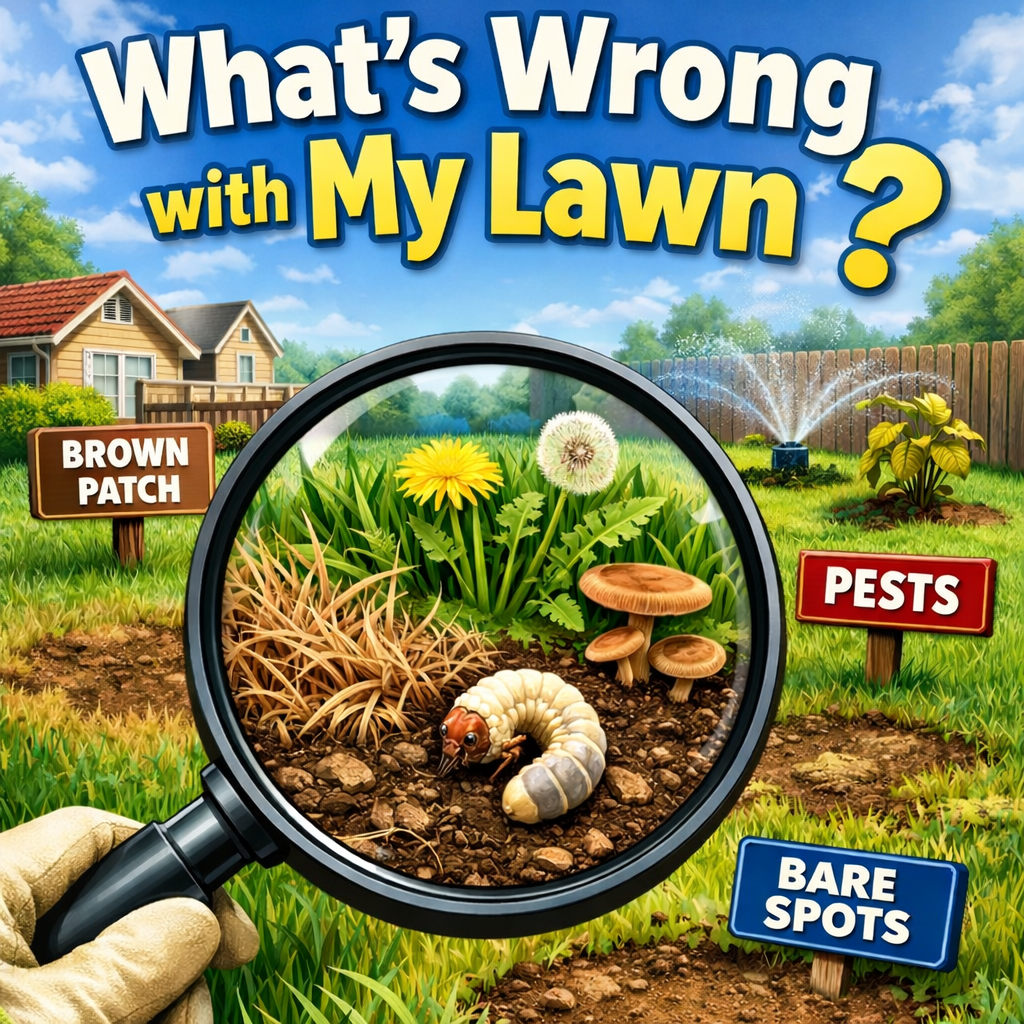
You walk outside, coffee in hand, ready to admire your beautiful grass… and instead you see yellow streaks, brown patches, or thin, crunchy turf. You’re not alone; most “lawn problems” boil down to a surprisingly small group of issues: Lawn Fungus, Soil Compaction, Iron Deficiency, Nitrogen deficiency, and Over Watering. This guide is built like the best YouTube lawn channels and top lawn care books: real-world diagnostics first, then simple, evidence-based fixes. Think of it as having a pro walk your yard with you, step by step.
Quick 5-Minute Lawn Diagnosis: Identify What's Wrong with My Lawn?
- Color check. Is your lawn uniformly green, or do you see yellow, gray, or brown areas?
- Pattern check. Are problems in circles, streaks, strips, or random patches?
- Soil feel test. Is the soil hard like concrete, or does a screwdriver slide in easily?
- Moisture test. Is the soil soggy near the surface, dusty-dry, or just slightly damp?
- Pull test. Does the grass resist when you tug, or does it come up with short, weak roots?
If you're looking at your lawn and wondering, what's wrong with my lawn? This question is crucial for identifying lawn issues. This common question can lead to effective solutions. Understanding common issues helps you take action. Many homeowners share this concern. This guide helps you diagnose lawn issues quickly. Before buying products or booking services, quickly walk your yard. Top lawn pros and extension specialists start with a simple routine:
- Color check. Is your lawn uniformly green, or do you see yellow, gray, or brown areas?
- Pattern check. Are problems in circles, streaks, strips, or random patches?
- Soil feel test. Is the soil hard like concrete, or does a screwdriver slide in easily?
- Moisture test. Is the soil soggy near the surface, dusty-dry, or just slightly damp?
- Pull test. Does the grass resist when you tug, or does it come up with short, weak roots?
These five checks reveal five main lawn issues. This method follows university diagnostic guides and turf videos.
Step 2: Identifying and Managing Lawn Fungus Problems
What's wrong with my lawn? If you're facing Lawn Fungus, it's the drama queen of lawn problems: it shows up fast, looks scary, and spreads quickly in the right weather. Luckily, it’s one of the most preventable issues once you know what to look for.
How to Recognize Key Signs of Lawn Fungus
Watch for these signs of common fungal diseases:
- Circular or irregular brown patches. These may start small and expand.
- “Smoke rings”. Darker or lighter rings around the edges of dead spots.
- Greasy or water-soaked blades. Especially early in the morning.
- Spider-web or cottony growth. On leaves under heavy dew.
Diseases like brown patch and Pythium blight thrive in warm, humid conditions with too much nitrogen and poor drainage. When temperatures and humidity spike, and you water frequently, your lawn becomes a perfect petri dish for fungus.
Distinguishing Lawn Fungus from Other Issues
Before using a fungicide, consider these questions:
- Did the problem appear quickly after hot, humid weather?
- Is it in defined patches or rings, not just overall paleness?
- Do blades have spots, lesions, or fuzzy growth?
Warning:
If you answered “yes” to most questions, Lawn Fungus is likely the culprit.
If the lawn is just uniformly pale or yellow without distinct lesions, you’re more likely dealing with a nutrient issue like Nitrogen deficiency or Iron Deficiency.
Effective Strategies to Fix and Prevent Lawn Fungus
- Change how you water. Water deeply but infrequently, early in the morning, so blades dry quickly.
- Improve airflow and thatch. Mow at the right height, bag clippings only when thatch is thick, and trim overgrown shrubs that block airflow.
- Fertilize smart. Avoid heavy nitrogen applications in peak disease season; dense, succulent growth is a fungus magnet.
- Use fungicides when truly necessary. Choose products labeled for your grass type and specific disease and apply on schedule.
Think in this order: environment first, then products.
- Change how you water. Water deeply but infrequently, early in the morning, so blades dry quickly.
- Improve airflow and thatch. Mow at the right height, bag clippings only when thatch is thick, and trim overgrown shrubs that block airflow.
- Fertilize smart. Avoid heavy nitrogen applications in peak disease season; dense, succulent growth is a fungus magnet.
- Use fungicides when truly necessary. Choose products labeled for your grass type and specific disease and apply on schedule.
For a more technical breakdown of common lawn diseases and their management, extension-style guides such as the UC IPM lawn diseases resource show exactly how cultural practices and fungicides should work together.
Step 3: Understanding Soil Compaction and Its Impact on Lawn Health
What's wrong with my lawn? If Lawn Fungus is the loud, obvious problem, understanding what's wrong with my lawn is crucial for effective management strategies. Soil Compaction is the quiet one that sets everything else up to fail. Compaction happens when soil particles press tightly together, blocking air and water. Roots suffocate, water puddles or runs off, and fertilizer fails to reach its target.
Signs of Soil Compaction to Watch For
Use these two simple tests:
- Screwdriver test: On a normal day (not bone-dry or freshly soaked), try pushing a screwdriver or small stake into the soil. If it won’t go in at least 6 inches without serious effort, you likely have compaction.
- Traffic pattern check: Look for worn paths where kids, pets, or mowers always travel. These areas usually thin out, turn brown, or host persistent weeds.
Soil compaction and poor drainage create ideal conditions for Lawn Fungus. Many guides recommend aeration and soil cultivation as primary prevention steps.
Proven Methods to Effectively Resolve Soil Compaction
- Core aeration, not spikes. Use a core aerator that pulls plugs out of the lawn. Spiking just pushes soil sideways; it doesn’t truly relieve compaction.
- Topdress with organic matter. After aeration, brush compost or a sandy/compost mix into the holes to increase porosity and organic content.
- Address chronic traffic. Add stepping stones, small paths, or move play structures to reduce repeated pounding on the same strip of turf.
- Core aeration, not spikes. Use a core aerator that pulls plugs out of the lawn. Spiking just pushes soil sideways; it doesn’t truly relieve compaction.
- Topdress with organic matter. After aeration, brush compost or a sandy/compost mix into the holes to increase porosity and organic content.
- Address chronic traffic. Add stepping stones, small paths, or move play structures to reduce repeated pounding on the same strip of turf.
Compaction is a foundational problem. Many “lawn rescue” videos focus on a one-two punch of aeration and topdressing. If your lawn feels like concrete, start with these steps.
Step 4: Identifying and Correcting Iron Deficiency in Your Lawn
What's wrong with my lawn? If you suspect Iron Deficiency, this is another common issue that can be sneaky and often overlooked. The lawn is clearly yellowing, but fertilizer “does nothing,” and disease treatments don’t help. This often relates more to soil chemistry than the amount you feed.
How to Identify Signs of Iron Deficiency in Your Lawn
- Yellow or pale green blades with green veins. This is known as interveinal chlorosis, especially on newer growth.
- Striped or streaky yellowing. This occurs along mower paths or across sections of the lawn.
- Grass still relatively dense. It is not necessarily thin, bare, or patchy at first.
This often shows up in soils with higher pH (more alkaline) or in areas where Over Watering or Soil Compaction keeps roots from taking up iron effectively.
Effective Solutions to Correct Iron Deficiency
- Get a soil test. Don’t guess. A lab test will tell you your pH and whether iron is present but “locked up.”
- Adjust pH if needed. If pH is too high, use elemental sulfur or other acidifying amendments to gradually bring it into a turf-friendly range.
- Use chelated iron products. These are more available to plants, especially in higher-pH soils, and can green things up quickly.
- Fix the root cause. If roots are stressed by compaction or waterlogging, address those issues or the deficiency will come back.
Small changes can create a big visual impact for iron deficiency. Correcting both the chemistry and root environment can turn a dull lawn vibrant green in days.
Step 5: Understanding and Managing Nitrogen Deficiency in Your Lawn
What's wrong with my lawn? If your lawn just looks “tired” – pale, thin, and slow to recover from wear – you might be dealing with Nitrogen deficiency. Nitrogen fuels your lawn's growth and color. Without enough, your lawn can’t thicken up or compete with weeds.
How to Recognize Symptoms of Nitrogen Deficiency in Your Lawn
- Uniform light green or yellowing across large areas, without distinct lesions or spots.
- Slow growth – you’re not mowing as often as usual.
- Thin turf and more weeds creeping into bare spaces.
- Poor recovery from foot traffic, heat, and drought stress.
For many cool-season lawns, apply about 4–6 pounds of actual nitrogen per 1,000 square feet each year. Split this into multiple applications instead of one large dose. Too little, and the lawn starves; too much at once, and you feed disease and thatch.
Proven Steps to Safely Correct Nitrogen Deficiency
- Choose the right fertilizer. Look for a balanced product with a good percentage of slow-release nitrogen to avoid growth spikes.
- Follow a seasonal schedule. For cool-season grasses, this often means lighter doses in late spring and heavier emphasis in fall; warm-season grasses shift toward late spring and summer feeding.
- Respect the 1 lb rule. Don’t apply more than about 1 pound of actual nitrogen per 1,000 square feet in a single treatment.
- Pair feeding with soil health. Aeration, organic matter, and proper watering help your nitrogen dollars actually pay off.
Nitrogen deficiency is also closely tied to Over Watering and leaching – if you’re constantly soaking the lawn, nutrients literally wash out of the root zone.
Step 6: Understanding Overwatering Risks and Solutions for Your Lawn
What's wrong with my lawn? Overwatering can harm lawns more than underwatering and lead to problems mistaken for other issues. Over Watering suffocates roots, fuels Lawn Fungus, and wastes fertilizer. A lawn that is babied with constant shallow watering will never develop deep, resilient roots.
How to Identify Signs of Overwatering
- Soggy or squishy soil. This is underfoot, even a day or two after rain or irrigation.
- Algae, moss, or mushrooms. These appear in shady or low-lying spots.
- Yellow, limp grass. This pulls up easily due to shallow or rotting roots.
- Frequent fungal outbreaks. These occur especially after warm, rainy periods.
Experts recommend deep, infrequent watering. Aim for about 1 inch of water per week (from rain and irrigation combined) for many turf types, adjusted for climate and soil.
Effective Strategies for Lawn Water Management
- Measure your output. Set out shallow containers (like tuna cans) and run your sprinklers to see how long it takes to deliver 1 inch.
- Water early in the morning. This reduces evaporation and leaf wetness duration, which is key for Lawn Fungus suppression.
- Skip days when it rains. Simple, but often ignored. Modern controllers and smart timers make this easy.
- Fix low spots and drainage issues. Level depressions, add drains where necessary, and combine this with aeration to improve infiltration.
- Measure your output. Set out shallow containers (like tuna cans) and run your sprinklers to see how long it takes to deliver 1 inch.
- Water early in the morning. This reduces evaporation and leaf wetness duration, which is key for Lawn Fungus suppression.
- Skip days when it rains. Simple, but often ignored. Modern controllers and smart timers make this easy.
- Fix low spots and drainage issues. Level depressions, add drains where necessary, and combine this with aeration to improve infiltration.
If your lawn has yellow patches in low spots and a history of disease, changing your watering routine can greatly help. It’s often more important than any product you can buy.
Quick Reference Guide: What’s Wrong with My Lawn?
- Circles or rings of brown grass with defined edges: Likely Lawn Fungus.
- Hard, cracked soil, thin grass where people walk: Likely Soil Compaction.
- Yellow streaks or striped blades but decent density: Likely Iron Deficiency.
- Uniform pale green or yellow, slow growth, more weeds: Likely Nitrogen deficiency.
- Soggy soil, mushrooms, shallow roots, yellow limp grass: Likely Over Watering.
What's wrong with my lawn? Use this quick reference to match what you see in your yard to the likely causes of lawn issues, including common problems like Lawn Fungus and other related concerns.
- Circles or rings of brown grass with defined edges: Likely Lawn Fungus.
- Hard, cracked soil, thin grass where people walk: Likely Soil Compaction.
- Yellow streaks or striped blades but decent density: Likely Iron Deficiency.
- Uniform pale green or yellow, slow growth, more weeds: Likely Nitrogen deficiency.
- Soggy soil, mushrooms, shallow roots, yellow limp grass: Likely Over Watering.
Multiple problems can occur at the same time. A compacted, overwatered lawn might show both Lawn Fungus and nutrient issues. That’s why pros fix the environment first and the symptoms second.
Importance of Soil Tests and Maintenance Schedules for Lawn Health
- Soil testing every few years. This checks pH and nutrient levels.
- Aeration and topdressing. These should be on a set schedule for compacted soils.
- Balanced fertilization. This avoids both Nitrogen deficiency and nitrogen overload.
- Watering routines. These should be based on weather, not the calendar alone.
What's wrong with my lawn? The most consistent theme in expert books and university guides is this: understanding what's wrong with my lawn and the underlying issues is key to effective lawn care. you need a basic plan to address lawn issues, not random reactions. Include this in your plan:
- Soil testing every few years. This checks pH and nutrient levels.
- Aeration and topdressing. These should be on a set schedule for compacted soils.
- Balanced fertilization. This avoids both Nitrogen deficiency and nitrogen overload.
- Watering routines. These should be based on weather, not the calendar alone.
Once these fundamentals are in place, managing Lawn Fungus, Iron Deficiency, or Overwatering becomes simpler.
You’ll just make targeted tweaks to a solid foundation.
Essential Resources for Effective Lawn Care
Did You Know?
If you want to explore more technical details on disease identification and evidence-based lawn care, university and extension publications are excellent resources.
- A few standout examples:UC IPM guide on lawn diseases and cultural management
- Missouri Extension’s turfgrass disease control publication
- Wisconsin horticulture quick reference for lawn disease identification
- University of Maryland overview of lawn diseases and management
- Clemson HGIC fact sheet on leaf diseases of lawns
Use these references for a deeper understanding as you follow the practical steps in this guide. With a good diagnostic routine and a focus on soil, water, and nutrients, most “mystery” lawn problems turn into manageable, predictable projects instead of frustrating surprises.